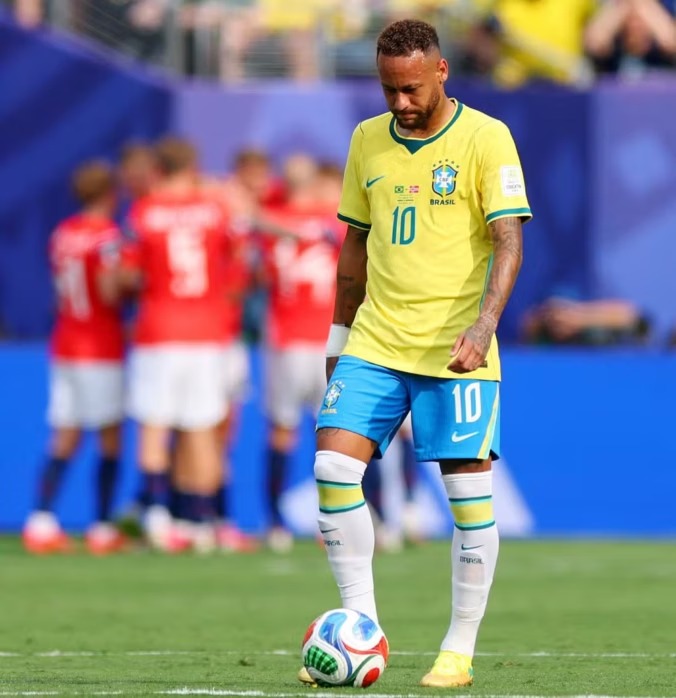
Any year in which Brazil beat Norway at skiing and Norway beat Brazil at football would be a strange one even before considering everything else that has also happened, both in the world of football and beyond, to make 2026 the let’s-put-it-diplomatically adventure it has been. I never got to watch Brazil play a World Cup game in person; I never even got tickets to any World Cup games in person. Instead I watched on TV and watched the prices go up and up and up and spent a portion—only a portion—of the probably fifteen hundred dollars I would have needed to actually go to one of Brazil’s games to go sit by a beach in Maine for a few days and eat as much lobster as I could stomach1 and still got back home in time to watch Brazil give up sixty-six percent possession and two late goals to Norway from the comfort of my local bar and the two hands into which I had buried my head by the end.
It was Brazil’s worst World Cup result in 36 years, by dint of the additional round of knockout games meaning the second knockout round, where Brazil have now been eliminated in five of six World Cups post-2002, was the round of 16 rather than the quarterfinals. It was probably the worst of those eliminations just based on the caliber of opponent who beat us; at least in years past we lost to France, the Netherlands, Germany—even Belgium and Croatia went on to finish third. (Even in our last round of 16 elimination, to Argentina in 1990, we lost to a team that made it to the final. Also, they drugged our players.) Norway lost, though in extra time, to England, reinforcing the notion that Brazil not only isn’t good enough, but continues to be in active decline. Nor did we achieve the scant comfort of the Seleção finally ridding itself of its post-2002 hex of losing to every European opponent it faces in the knockout rounds; this makes seven straight knockout-round losses to European teams. I thought for sure that Carlo Ancelotti, even with only a year to whip a historically weak and mismanaged team into shape, could at least manage some marker of clear improvement like that. Instead, his tenure (his contract was extended through 2030, for better or worse) already has the stench of failure coming off it.
I have been meaning to rewatch the game, and holding off on actually doing so. I know what I think right now: Ancelotti and Brazil, terrified of the damage Erling Haaland might cause, cravenly surrendered the initiative and run of the game to Norway in an attempt to contain Haaland and conceded two goals to him anyway. Or, with Brazil’s talent pool desperately short in key areas and only made more so by crucial injuries, Norway were able to exploit their major weaknesses. Or Ancelotti, knowing that Brazil would struggle to compete in the midfield, set up the team to just try and keep Norway and Haaland at arm’s length when defending and counterattack quickly and decisively, a strategy that, with slightly better execution, might have worked. Or that things were going fine until the questionable decision to bring in a barely-mobile Neymar for the last half-hour.
Alright, fuck it, enough stalling. It’s been a literal month. I’m finally rewatching the game.
[Two hours later]
Hmm. I was worried that’d be a pointless exercise and that it wouldn’t really change what I wanted to say. That proved not to the case. The rewatch refined my takeaway down to a single, simple, overarching point: this game, and Brazil’s entire World Cup campaign, ultimately came down to a team that didn’t have as many tools as it thought.
I’ll explain that with a moment that wasn’t actually terribly illustrative of the general pattern of play. Within the first three minutes, Patrick Berg had the ball in the back of Brazil’s net, but the goal was disallowed for a clear offside from Alexander Sørloth. Look at the positioning of our three midfielders (whom I’ve labeled along with Berg; Gabriel Martinelli counts for this purpose) at the moment Sørloth cut the ball back for Berg.

All three are wildly behind the play and clustered on the far side of the pitch, leaving a gigantic void between them and the back four into which no fewer than three onrushing Norwegians have made themselves available. That’s obviously pretty catastrophic (it doesn’t help that they’re all trotting back like they’ve given up on the play, but let’s give them the benefit of the doubt and say that they saw the clear offside), but why were they chasing behind the play to begin with? Take a look at this screenshot from moments earlier (this wasn’t in any of the highlight videos on YouTube, so I resorted to taking a photo of the TV):

If you’re having trouble finding the ball in that image, it’s at the feet of one of the five Brazilians squeezing into a Manhattan-studio-apartment-sized rectangle on the far touchline in a gross parody of Fernando Diniz relationism. (Leave aside that Fernando Diniz relationism may already be a parody of itself.2) Brazil has just won back possession in this image, but moments later Bruno Guimarães is pressured into a bad backpass which bounces off Haaland into Norwegian control, they slice through this cluster of yellow shirts and into the space behind them in a couple of passes, and seconds later the ball is in the net.
Yes, more hustle from the midfielders once Norway had won the ball back could well have prevented the chance that followed. Maybe Casemiro didn’t have the legs to do so—every one of his thirty-four years on this Earth became painfully apparent during the tournament—but Martinelli sure did, and he didn’t do much more to try and get in the box to cover Sørloth’s cutback. So perhaps this was just a breakdown of coaching, and Carlo Ancelotti should have drilled his players to sprint back in situations like this.
I want to sidestep that whole conversation, though, because this actually was not a typical pattern of play in this game at all. Brazil rarely tried to win the ball high up the pitch at any point during the game—hence why Norway had two-thirds of the possession—and when they got the ball, they usually sprinted forward immediately on the counterattack or the quick transition, even though on the occasions when they did hold onto the ball, they showed they were eminently capable of slowly but effectively working it up the field and creating dangerous chances. Indeed, when they had the ball, whether it was in transition (improvising Martinelli as a midfielder was something of a masterstroke in this regard, as he did really well to carry the ball into open space to launch counters) or these longer possessions, I actually thought Brazil were pretty good, end product aside. But while they had the ability to hold the ball, they seemed not to want to. While there were a few sequences when they created several chances in succession by staying in Norway’s final third and putting pressure on their defense, such as in this series of corners around the 60th minute, once Norway had a chance to break out of that pressure (in that case, with a free kick after an offside call), Brazil always retreated back and let Norway have the ball rather than trying to sustain that presence high up the field.
I think Brazil knew that if they didn’t retreat, that if they pushed numbers forward to try and win the ball rather than absorbing pressure and waiting for their moments to strike on the counter, what happened in those first three minutes would happen again. If Norway won the ball, Brazil’s midfielders would be overcommitted and easy to bypass, leaving huge spaces to exploit in front of the back four. Indeed, we saw something similar at almost the same three-minute mark of the second half, and it once involved Patrick Berg receiving a pass in a vast and untroubled ocean of grass in which to pick a shot:

Here’s where the rest of my thesis started to crystallize. Moments before this frame, Bruno and Martinelli had joined Matheus Cunha in trying to win the ball off the Norwegians, only for it to be played around them with ease and leave them trying to catch up to Berg as he advanced into Brazil’s half. Moments after this frame, Berg will square up to Casemiro—once one of the most fearsome defensive midfielders in the game, a man who, though he no longer has the speed he once did, is perfectly positioned to face Berg down and make this tackle—and step around him like he’s not there. Even a young Casemiro would have been hard-pressed to cover the whole exposed width of the pitch here, but he ended up not having to; Berg came right to him, and he still couldn’t stop him. Berg ultimately took a shot that ended up, as best I can figure, roughly on Mars, but we saw something similar happen every time Norway put the ball in the net. Andreas Schjelderup breezed past Endrick before crossing to Haaland for Norway’s first goal. He froze Marquinhos with the simplest of cutbacks before setting up Haaland for the killer second goal. As he set up Berg for the early disallowed goal, Sørloth left Douglas Santos on the ground—or, rather, Santos tried to stop him and just kind of bounced off him. You can say that Brazil were too afraid of Haaland for their own good—Ancelotti himself admitted after the game that he took the cautious, ceding-possession approach with a specific eye towards preventing Haaland from getting the ball in space—but I think that’s almost a distraction from the root issue. When it mattered, Brazil’s players just weren’t as good as we needed them to be… or thought they were.
Even so, things almost worked out. Ørjan Nyland saved Bruno’s penalty in the fourteenth minute, and that, or Endrick’s missed 1v1 chance in the second half, or any one of the half-dozen other shots, balls across the box, and deflections that flashed across goal or into Nyland’s arms to no greater effect than a collective oof, might well have swayed the game. (I don’t think Haaland would have been so readily allowed to score his second goal if Brazil weren’t still reeling from conceding such a late go-ahead goal, as opposed to if his first goal had simply been an equalizer.)
But things didn’t work out, and as much as that’s a result of bad luck, it’s also downstream from not having the tools that would keep us from having to rely so much on luck. Bruno took a bad penalty, and there’s a case to be made that Vini, as the star of the team, should have been given the responsibility in that moment, but the truth is that neither of them has much of a resume as a penalty taker (and even after Bruno’s miss, Vini’s is probably still thinner). Indeed, nobody in the starting XI did. Marquinhos and Gabriel Magalhães famously missed recent high-stakes attempts; for the most of the rest of the lineup, they generally didn’t have much of a body of work to show. (At the extreme end, would you believe that Casemiro of all people has never taken a penalty as a professional?3) Bad luck with injuries cost us most of our more pedigreed takers—Raphinha wasn’t fit to play; Neymar probably wasn’t either even though he did play (more on him later, but he did effortlessly bury his Pyrrhic penalty at the death, jawing with Nyland all the while); Lucas Paquetá was out for the rest of the World Cup after getting hurt in the previous game; Estêvão missed the tournament altogether—but we weren’t completely lacking on the bench. Say what you will about Igor Thiago, but he spent the entirety of the 2025-26 season absolutely crushing it as Brentford’s go-to penalty taker; unfortunately for him, Matheus Cunha, who has taken fewer penalties in his career than Igor scored just last year, was a much better fit for the quick-transition, dribbling-first strategy Ancelotti employed.4
And I can’t say it was wrong, given the choice between those two, to have gone with Cunha and trust that not having a reliable penalty taker on the pitch wouldn’t doom the team. (Even a bad penalty still goes in more often than not, after all.) But these are compromises I’m not used to Brazil having to make. Brazil had to forego starting an elite penalty taker because their best one available wasn’t good enough with the ball at his feet to play the transition game they felt they needed to play because they couldn’t afford to expose the midfield because all the available players in that zone were old and slow and (Bruno excepted) bad. It all feels to me like the old cliché about having a blanket that’s too short to cover both your shoulders and your feet, so you have to figure out which part you’d rather leave out in the cold.
You may well have noticed by now, and rightly so, that I have yet to say much of anything about the role of coach Carlo Ancelotti in this whole mess. Was it (option A) all his doing, or (option B) were his hands tied by the lack of quality he had available? Well, he signed a contract extension just before the tournament that will keep him in charge through the next World Cup, and even if this loss had been enough to cost him his job, we have to ask ourselves who else could feasibly have replaced him and not been worse, because I’m not sure anybody currently coaching in Brazil would fit that bill. In other words, we’d better fucking hope it was option B.
Here are some arguments for why it wasn’t. First and foremost, he picked this team, including its very small group of largely deficient midfielders, and while Casemiro had a very good club season and only aged 200 years in 30 seconds once the World Cup started, Ancelotti chose to back him up with Fabinho, a similarly old and slow player. Of the five midfielders he initially chose for the World Cup squad before Wesley’s injury allowed him to bring in Éderson, only Danilo Santos, maybe, comes anywhere close to fitting the label of a dynamic, energetic midfielder. (Bruno and Paquetá are perfectly serviceable athletes, and the former especially is a genuinely great player who had a great World Cup aside from the penalty miss, but their strength is not in speed or tireless running.) I’m not saying that someone like Andrey Santos or João Gomes, whom I’ve described multiple times on this blog as “a dart without feathers”, would have necessarily improved the team, but perhaps Ancelotti should have placed more value on what players with that sort of youth, mobility, and energy could have brought to the team. And midfield wasn’t the only place where Ancelotti made questionable selections, although the only other position where I think his choices actually hurt Brazil in practice was right-back. It turns out I was right to say Roger Ibañez is terrible (he got yanked at halftime against Morocco after getting torn apart multiple times and never saw the field again) and that I’d rather gamble on a complete unknown than rely on the utterly insufficient Bad Danilo, who for the second World Cup running proved completely incapable of offering any resistance against the goals that eliminated Brazil.

Actually, there’s one more personnel choice that might have hurt the team. You know it, I know it.
The selection of Neymar was a total mess even before we learned he was carrying a calf injury that meant he wouldn’t be able to train properly, let alone play, until after the tournament started. Dropping João Pedro to make room for him was a questionable choice even considering that the Chelsea striker has never once looked close to replicating his impressive Premier League form in a Brazil shirt.5 I defended the idea of bringing Neymar to the World Cup, but in the end all we really got from him was an idea, the ghost of a great player whom injuries and his own apparent lack of a commitment have plucked from our grasp. He was no great shakes when he came on against Scotland for a little kickabout with his buddies.6 (Some folks crowed about him creating 3 chances in just 15 minutes or whatever, but I’ve seen the stats: those chances were worth a total of 0.07 expected goals, or what statisticians call “jack shit”.) For him to suddenly come on just before the hydration break for the final quarter against Norway, with the game still tied, becomes more baffling the more I look at it. Brazil enjoyed a decent little 40 seconds of possession right after the break, which ended when he badly overhit his first pass attempt. From there until Norway opened the scoring, roughly 7 minutes and 50 seconds later, Brazil completed just eleven passes, only one more than they’d managed in that little 40-second spell. If they’d spent most of the game not holding onto possession by choice, now they were totally incapable of doing so.
I don’t even attribute this to Neymar specifically, though his inability to contribute defensively or do anything productive with the ball was obviously a huge factor. Rather, Ancelotti’s whole tactical switch at his introduction was just bizarre. He gave his rationale in his own words in a postmortem interview with Globo: in putting Neymar on the field, he was thinking about “retaking control of the game. Putting more quality in attack to win the game.” Perhaps that explains why he also brought on Danilo Santos at the same time, replacing Martinelli and Rayan and finally giving us three true midfielders on the pitch and give the attackers more defensive solidity behind them. Unfortunately, this personnel swap basically undermined everything about Brazil’s attack that had been working up to this point.
Improvising Martinelli as a pseudo-midfielder, it turns out, had been key to the team’s entire counterattacking strategy: he regularly launched attacks by coming very deep, getting the ball when Brazil won it back, then dribbling through the Norwegian press into open space from which he could surge forward or distribute to his teammates. (That’s why I’ve barely said anything about Ancelotti calling up so few midfielders, or his bizarre insistence on the same 4-2-4 that has failed every other Brazil coach in recent years; in the end, ironically enough, the team was better with an improvised forward as a midfielder than a proper three-man contingent in the zone.) Rayan, though not as influential in the game, had caused Norway problems with his speed and especially his six-foot-two-inch height on a few occasions. Shortly before he was subbed off, he’d been at the heart of Brazil’s best sustained series of chances, stinging Nyland’s palms from the edge of the box and then setting up Bruno Guimarães from point-blank range with a headed knockdown. Martinelli and Rayan’s speed and size were key to their influence on the game, and their replacements, Neymar and Danilo, were slower and shorter than either of them. Even if those two had been able to give anything like their best, it’s hard to see them how they would have worked within the established counterattacking strategy, let alone provided enough threat threat in the air or with their speed to dissuade Norway from pressing forward and leveraging their physical advantages.
I wouldn’t be surprised if Ancelotti was hoping to move away from the counterattack, and instead use Neymar and Danilo’s ability on the ball to help Brazil keep possession high up the field for prolonged stretches in just the way they’d been reluctant to do before that point. It might even have worked, but once again Brazil ran into the same problem as they had all game: the players they tried to rely on just weren’t as good as we all hoped they were. Neymar, already tragically diminished by years of serious injuries, clearly still wasn’t fully match fit after missing so much training with his latest calf problem and could barely run. But Danilo was also terrible, flubbing his passes and struggling every time he got pressured—so bad when combined with his other lackluster showings at this World Cup, in fact, that I no longer feel it is appropriate to dub him “Good Danilo”.7
And I can’t believe I’m only now getting to this other reason for blaming Ancelotti, considering I harped on it repeatedly during the tournament itself. On several occasions, most notably against Haiti and Japan, it felt like Brazil chose not to exert themselves to press their clear advantage in the game. Up 3-0 at halftime against Haiti, Brazil spent the second half sitting back and making little effort to press the ball—much like we did against Norway—rather than try and add to the lead against the weakest team in the group, even knowing that more goals would have helped our odds of beating Morocco on goal difference, which we ultimately did regardless. It was frustrating, but it made some sense: bet—correctly, it turned out—that Morocco couldn’t outscore us, and save our energy for tougher games later on. The Japan situation was more concerning. After falling behind early, we tied the game on the back of a relentless 10-minute attacking surge early in the second half, during which we came agonizingly close to scoring at least two other goals. After that, though, almost as if Ancelotti was coaching from a parallel dimension where one of those other chances had gone in and given us the lead, we let off the gas and created very little of note until Gabriel Martinelli popped up with a stoppage-time winner. It was a very un-Brazil-like way of playing, as was settling for Brazil’s lowest possession figure in a World Cup game since possession stats started being tracked in 1966, and admitting that you did so because you feared a particular opposition player.
There is a very good case to be made that the choice to make the country of jogo bonito play in such a philosophically repulsive manner should in and of itself get Ancelotti fired, particularly since it didn’t even come close to outperforming Brazil’s other recent World Cup failures, but Ancelotti’s job seems safe for now, so I’d like to end by tacking in a slightly more exculpatory direction.8 While watching the Norway game live, the first thing I thought of was that, like against Japan, it was as if we were playing in a parallel universe where Bruno’s penalty had gone in and we’d taken an early lead. On rewatch, however, I’ve changed my mind. Bruno’s penalty miss didn’t really change anything about how Brazil approached the game; the game plan was always to sit off Norway and wait for the right moment to pounce regardless. And that deepens my suspicion that we simply didn’t have the tools to play more aggressively, or at least that Ancelotti didn’t think we did.
In all five of our World Cup games, Brazil’s players covered less distance than the opposition, with the biggest disparity (and the lowest distance covered by Brazil) coming against Norway. This on its own says little—Argentina and Switzerland, the two teams that covered the least ground, both made it farther than we did, and we even ran more than France—but add it to the evidence of your eyes and ears. Combine it with those screenshots I dissected above, in which there are huge voids between the midfield and defense and Bruno, Casemiro, and Martinelli are, at best, jogging back to cover. Why, after four games of keeping our powder dry, of trusting that we could live to fight another day without burning up the energy necessary to make another sprint up the field, were we still the team that looked like it had nothing left in the tank when it really mattered? Was it just because of all the agèd players Ancelotti selected? Was it because he never properly accounted for his key players’ lack of pace or stamina? That he didn’t give them a rest in the group stage? (Norway, notably, rested most of their starters, including Haaland, in their final group game against France. They got rocked 4-1, but their performance in the knockout rounds suggests they made the right call.)
Or was it something else, the product of a more profound erosion? The Seleção has long had a reputation for emphasizing physical preparation and having a fitness advantage over their competitors at World Cups. However, this is now the third straight World Cup where, to my mind, fitness and athleticism was a detriment to Brazil’s tournament rather than a benefit. If you need a reminder:
2018: I maintain to this day that a big factor in Brazil’s loss to Belgium was that we simply didn’t have the tools to deal with their exceptionally tall and physically strong lineup, especially since our resident tall strong guy Casemiro was suspended for the game and Tite inexplicably opted not to bring the similarly tall Fabinho to the World Cup as his obvious backup. Obviously we would have had to deal with a height difference regardless (all our skill players that year were somehow 5-foot-9, while only two of Belgium’s starters were under 6-foot-1), but it really felt like we didn’t have a plan for how to do so.
On top of that, the team’s management of several players’ injury situations was questionable. Douglas Costa showed up to training with an injury to one hamstring and injured the other against Costa Rica. Danilo started Brazil’s first game, hurt something in his quad before the second, and then hurt an ankle ligament in training two weeks later, ending his tournament without his having played in another match. The strangest case by far was Fred’s; he hurt his ankle in training after a clattering from Casemiro ten days before Brazil’s first game, and Tite seemingly downplayed the severity of his injury, keeping him in the squad even though he was never fit enough to play, possibly because he didn’t trust his potential replacements. While Tite justified some of these training injuries as “the price of excellence”, Renato Augusto pointed to an “overload” of training as part of the reason behind his own knee inflammation.
2022: With a spot in the knockout rounds already clinched, Brazil rested the entire first-choice XI for the final group stage game against Cameroon. On top of that, the team was able to essentially sleepwalk through the entire second half of the round of 16 game against South Korea, having built a 4-0 lead by halftime. Croatia’s final group stage game, meanwhile, was a winner-take-all match against Belgium, and after gutting that out, they gutted out 120 minutes against Japan in the round of 16 before winning on penalties. Despite having played something like one and a half fewer games’ worth of football over the previous week, it was Brazil, not Croatia, who were visibly exhausted and cramping as the game rolled into extra time. (I noted in my postmortem of that game that Croatia’s tying goal was downhill from Éder Militão and then Danilo both struggling with cramp in the final minutes.)
A whole boatload of players also got hurt during this tournament. Neymar, Alex Sandro, and Danilo all picked up fairly minor knocks during the group stage, but others weren’t so lucky. The injury that took Richarlison off against Croatia kept him out for a month, and Alex Telles and Gabriel Jesus both suffered knee injuries against Cameroon that kept them out for two and three months respectively and, in Jesus’ case, required surgery. Unlike 2018, I believe these all happened during games and not training.
2026: Front and center here has to be the scandal surrounding Neymar’s injury status. He felt a calf issue while playing for Santos against Coritiba the day before the World Cup squad was announced; after he joined up with the Seleção, team doctor Rodrigo Lasmar revealed that the injury was much worse than the club had let on and he’d need at least two to three weeks to recover. Santos claimed they had been fully transparent with the national team staff; a conspiracy theory swirled that the refereeing controversy from that game against Coritiba, in which Neymar was apparently subbed off by mistake, was in fact all a ruse to not make it look like he’d had to be subbed off due to injury. Ancelotti and company ultimately decided not to cut Neymar from the squad, and we know the rest: he recovered enough to play—albeit after about five weeks, not two to three—but he was so clearly so short of match fitness that it’s baffling that Ancelotti subbed him on during a crucial knockout round game.
Shortly after the tournament ended, Manchester United pulled out of a proposed deal for Éderson, which Globo reported was out of concern for the long-term health of his knee, on which he’d had a major reconstructive surgery as a U-20 player and a more minor arthroscopic procedure while with Atalanta last year. It’s not clear that this actually hampered him on the pitch at all (he played a full season after the procedure without issue) and given that he was called as a last-minute replacement for the injured Wesley, Brazil might have had to trust the club’s assessment of his fitness rather than examine him themselves. But it’s weird that this was an issue twice in the same tournament, wasn’t it?
As far as fresh injuries, the tally this year was a shade lighter. Wesley was cut from the squad after getting hurt in a pre-tournament friendly against Egypt. Raphinha came off injured against Haiti and might have been able to return for the quarterfinals. Lucas Paquetá suffered a tournament-ending hamstring injury in the round of 32 against Japan. More debilitating were the injuries to Militão, Estêvão, and Rodrygo that kept them from being part of the squad to begin with, but these had nothing to do with the Seleção. (Though Estêvão claimed to have miraculously healed by the time the World Cup had started, countermanding the prognosis of both the Brazil and Chelsea doctors.)
And let’s not forget everything else I just wrote about Brazil seeming to run out of energy before their opponents, despite having had every opportunity to rest and rotate their squad.

Does three World Cups a pattern make? Have I just forgotten with time the subtle injuries that cost us previous editions? Perhaps, but I don’t think the reason Germany blew us out of the water in 2014 is because we were too exhausted to keep up with them, and it’s certainly not the case that poor physical preparation or overwork in training made it easier for Juan Zuñiga to break Neymar’s back.9 And while Neymar in 2014 and Elano in 2010 were indisputably debilitating injuries for their respective teams, I think they were the only injury that kept players out of games in their respective years.
There’s no one-size-fits-all explanation here. Tite’s penchant for physically rigorous training sessions might explain some of the issues in 2018 and 2022, but it obviously can’t explain this year. COVID-19 likely played a role, given how athletes who contract it appear to become significantly more prone to injury, but while that might explain the explosion in injuries suffered during the 2022 and 2026 tournaments, and potentially even the healthy players’ lack of stamina, at a certain point that entire analysis hinges upon the supposition that Brazilian footballers are statistically more likely than those from other nations to have gotten COVID10—and it doesn’t explain anything that happened in 2018. In lieu of a better explanation, I’d like to offer a scapegoat: Rodrigo Lasmar has been part of the Seleção’s medical department since 2002, but he only became its head after the 2014 World Cup. I don’t know if there’s anything to fault in his practice, but his tenure feels symbolic of the decline in Brazil’s physical readiness, and it does feel like something has gone wrong at a systemic level within the medical department, in keeping with all the other things that seem to have gone systemically wrong within Brazilian football for decades.
There might well be some degree a post-World-Cup-exit shakeup at the CBF. Certainly there have been rumors that Taffarel is not long for the goalkeeping-coach job, and he might not be the only one, though as of now I can’t find proof that any heads have actually rolled, unless you count Ancelotti’s son Davide leaving of his own accord to coach Lille, and I can find no word of any changes in the medical department. There’s perhaps some broader hope to be had with new CBF president Samir Xaud, who has pushed some long-overdue reforms, like decreasing the state championships’ impact on the calendar and new rules to bring the domestic league’s ball-in-play time more in line with the top European leagues, that will hopefully accelerate the Brasileirão’s recent upward trajectory.
Unfortunately, if you thought it was odd that the CBF installed as their president a young, well-kempt, forward-thinking technocrat instead of a nakedly corrupt probable sex pest who looks like his own Dorian Gray portrait, you were right to be skeptical. It seems that while we weren’t looking, the CBF has been somewhat captured by Francisco Mendes, son of the notoriously corrupt Brazilian Supreme Court justice Gilmar. Having found himself a spot in both one of the state football federations as well as being the only Brazilian on FIFA’s disciplinary committee (he claims he was not included in discussions about overturning Folarin Balogun’s red card) and benefiting from his family’s financial contributions to CBF Academy, the federation’s management and coaching school, he has become by many accounts the “most powerful” figure within the CBF. It was Francisco who took credit for Neymar’s inclusion in the World Cup squad—lending further credence to the longstanding suspicion that the Brazil coach has less than full autonomy when it comes to picking their team—and wouldn’t you know it, Xaud is a CBF Academy alum, suggesting that he comes with Francsco’s favor. His job seems to be safe despite the early World Cup exit, though the fact that that article cites both elder and younger Mendes’ judgment on the matter betrays their role in the process. Still, until they try to gut Brazilian football and sell it to private equity like a certain other president of a footballing federation recently tried to do, I’ll remain optimistic that even compromised as he is, Xaux has a better head for running the federation than all the corrupt old fossils who preceded him. Then again, I remember when I thought there was no way the next FIFA president could be worse than the corrupt old fossil that was Sepp Blatter, and look where that got me.
Frankly, I think I just want to finish on some level of positivity. I know in my heart of hearts that Carlo Ancelotti should have done better, even given the dire personnel situation he had to deal with; I know that Brazil is also producing fewer than ever of the kinds of elite players, especially at specific positions like striker, that are necessary for winning a World Cup; I know that there’s no way the institutions of Brazilian football make more than the most grudging, incremental, inadequate changes and that the new guys in charge will almost certainly suck just as much as the old guys did. But I want to believe that Ancelotti, with four full years to work with instead of just one, will cast aside the old players and strategies that failed him and embrace something younger, stronger, more exciting; that there are still young players coming through the pipeline that will make the 2030 team vastly better than the 2026 team; that even incremental changes can help strengthen Brazilian football in ways that will make the Seleção better at every level; that there’s One Weird Trick, like finding an amazing young number 9 or putting someone new in charge of the medical department, that will fix everything that’s wrong with the national team.
I’ll leave it there for now. I have written far too much, and still not managed to cover everything. Maybe I just needed to vent a lot, and cope a little. I’ll follow up with some sort of overview of what I think Ancelotti should prioritize at the start of this new cycle, and then… well, I’ll probably scale back my efforts on here for a while. Covering the World Cup took a lot out of me, and writing just this first part of the postmortem has taken way longer than I expected. When Brazil returns to action at the end of September for the three-game “super FIFA date”, don’t be surprised if I just put up one brief preview for all three games. I’ll make another call for this when it’s not stuck at the end of 7,000 unrelated words, but if you’ve got an idea for a Brazil World Cup Blog article—a retrospective of some classic match, a reevaluation of an unheralded player, something in the spirit of Black Matt’s silliness from back in the day, even an exhaustive rebuttal of everything I’ve written here—let me know.
For now, though, what more can I say than: welp… onward to 2030.
- I particularly liked The Bait Shed in Pine Point and McLoons Lobster Shack on Sprucehead Island. ↩︎
- I don’t want to sidetrack this discussion too much, but I’m starting to see what I’m going to call this relationist shape—the gravitating of all a team’s players toward a single spot on the field, especially in possession—as a hallmark of the Neymar-era Brazil, and perhaps thus of its problems. It started becoming clear to me when Neymar made his return against Scotland in the group stages and the entire Brazil attack started playing within maybe an eight-yard circle around him, the plan of attack collapsing into an elaborate training ground drill focused entirely on finding the perfect little one-touch pass slipped through an impossibly tight gap in the defense to create a golden chance. Suddenly I realized, I’ve seen this before, over and over again, throughout Neymar’s time as the face of the Seleção. His genius as a passer and dribbler makes such an approach natural, but this pattern of play often seems to arise even in spite of any coaching to the contrary, and as productive as it can be at its best, it’s a pattern that naturally involves trying to play through tight spaces, and Brazil often didn’t seem to have much desire to exploit other spaces as they opened up, whether that meant switching the play to the right flank when the defense had concentrated around Neymar on the left, or simply counter-attacking effectively.
And on the defensive side of the ball, I think we saw this same relationist shape whenever the team didn’t have a clear plan for pressing or winning the ball beyond throwing numbers at the problem. ↩︎ - The linked Transfermarkt page only shows penalties taken during regular gameplay, but while I didn’t try and dig up every shootout Casemiro might ever have participated in, I don’t think he even took a shootout penalty between the 2011 U-20 World Cup and… his stint at Manchester United over a decade later. (A 4-for-5 success rate isn’t bad, though.) ↩︎
- It’s all academic now, but there’s a certainly a case to be made that that Igor Thiago could or even should have started this game instead. He was the best defensive forward in the Premier League last season, which could have helped Brazil hold off or even dispossess Norway when they didn’t have the ball, and his height might have allowed Brazil to relieve pressure and get into the attacking third more quickly by aiming long balls up to him. ↩︎
- This didn’t really fit in the main text, but: while I am an unabashed João Pedro skeptic and therefore have a hard time seeing how, had he been called up instead of Neymar, he could have played his way into starting the Norway game ahead of Matheus Cunha, if he had been part of the team there are two things we should note: one, he is also an extremely good penalty taker; and two, unlike Neymar, he would have been fit enough to start the Norway game and thus take the penalty Bruno missed. (But I’m also not sure if he would’ve been a good stylistic fit for what Ancelotti was trying to do.) ↩︎
- See footnote 2; everyone collapsed in on him to try little passing drills with him, and it was made worse by the fact that he can’t really move anymore. ↩︎
- The other Danilo, however, will remain Bad Danilo until, God forbid, a worse Danilo comes along, or this Danilo miraculously redeems himself as a coach or something. ↩︎
- I’ll leave a spicier question for this footnote: was the football actually aesthetically repulsive on top of the approach being philosophically un-Brazilian? For all of Tite’s faults and the often staid way Brazil played during his tenure, they scored some truly wonderful goals. They only scored eight goals in 2022, but I could name three or four of those that wouldn’t have been out of place in our Greatest Seleção Goals of All Time bracket. What from this year reached that level? (Don’t think too much about the fact that we scored more goals this year than in either of the World Cups Tite coached—in fact, the only post-2002 World Cup in which Brazil scored more was 2014, in which we played two more, albeit ill-fated, games.) ↩︎
- Actually, I don’t know the first thing about physiotherapy or sports medicine. Could you make your vertebrae less breakable by strengthening the muscles around them? I know we have some PTs in the commentariat, and inquiring minds would like to know. (The answer’s gotta be no, right? Certainly for anybody in decent health?) ↩︎
- I think you could come up with a few possible reasons why this might be: the large number of COVID infections in Brazil, driven in part by then-president Jair Bolsonaro’s disastrous response (remember when he said the vaccine might turn you into a crocodile?); Europe-based players having more exposure to COVID during long flights overseas to go home or play for the national team; a possible lack of appropriate medical facilities relative to the US or Europe (though wealthy footballers certainly would have had access to top-tier care); the majority of players being Bolsonaro-loving, evangelical conservatives and thus buying into that movement’s anti-mask, COVID-denialist, pro-ivermectin rhetoric. But a proper accounting of the matter would probably take enough time and research to earn me a master’s of public health. ↩︎
Recent Comments