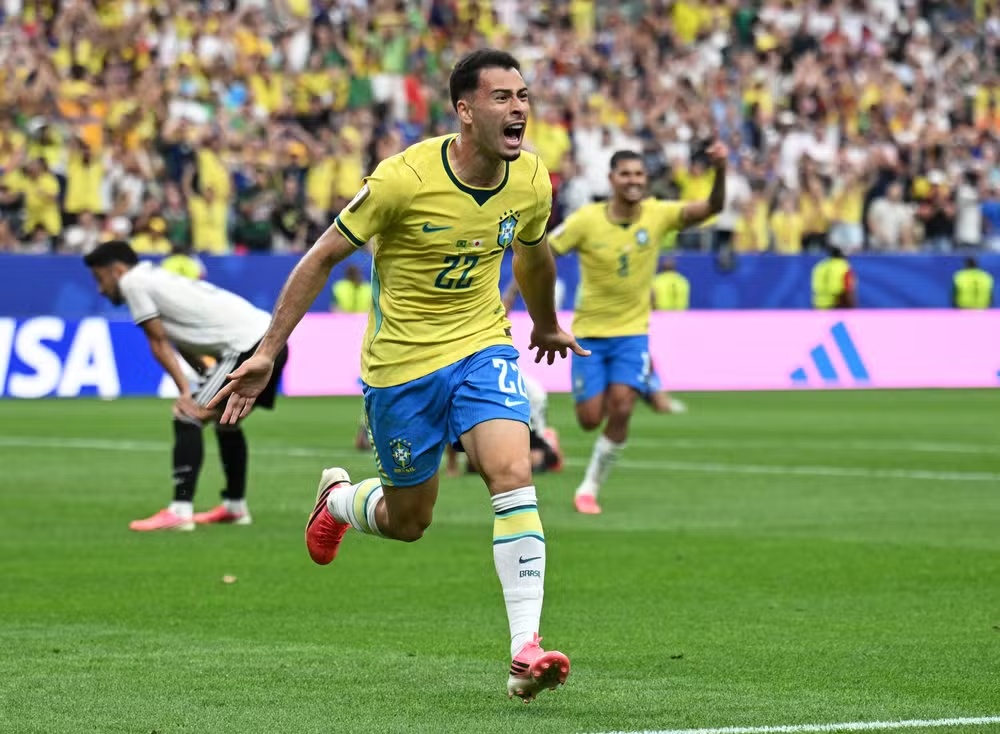
Well, I correctly predicted the score of the Japan game, though I don’t think it was right to say it “[wouldn’t] feel quite as close as the scoreline suggests”. While Brazil undeniably controlled the game, we didn’t turn our dominance into much in the way of clear opportunities, and Japan took the lead off, well, very much the same kind of goal that has doomed the Seleção at recent World Cups. At one point early in the second half, Casemiro had a point-blank header that ricocheted off three Japanese defenders without ever crossing the line or falling to a Brazilian to tap the ball home, and I couldn’t help but think, that’s the sort of lucky break a team gets when they’re fated to win. But just a few minutes later, Casemiro popped up in the box again and this time buried his header, and after some more huffing and puffing, Gabriel Martinelli silenced his doubters (me) with the game-winning goal in the fifth minute of stoppage time.
I do have a few complaints to make, mostly about how this victory felt more labored than it probably should. But let me start with the more positive spin. Brazil hasn’t won a hard-fought, come-from-behind game like this one at the World Cup in forever. In fact, the last time Brazil fell behind and still won in the knockout rounds at the World Cup was in the 2002 quarterfinals against England. That 24-year gap is the longest between such comebacks in the team’s history. And it’s not like Brazil had better outcomes in lesser tournaments. Across all the tournaments the senior and Olympic teams have played since then, I found only three such comebacks in the knockout rounds:
– With the last kick of the 2004 Copa América final against Argentina, Adriano scored arguably the most clutch goal in Seleção history to tie the game at 2-2 and send it to penalties, where Brazil won. This is also one of only a handful of times where we scored a game-changing goal in second-half stoppage time, and the only one in the knockout rounds. (Philippe Coutinho against Costa Rica at the 2018 World Cup and Casemiro against Colombia at the 2021 Copa América also come to mind.)
– In the 2009 Confederations Cup final, we spotted the USA a 2-0 lead at the half before coming back to win 3-2.
– In our 2012 Olympic quarterfinal, Honduras twice took the lead, although we completed the comeback by the 60th minute and won 3-2.
I didn’t keep a close count, but it seemed far more common for these sorts of close games to emerge because Brazil scored first and then conceded a tying goal before retaking the lead (see also: Brazil 3-2 Netherlands, 1994) or collapsing (see also: Brazil 1-2 Netherlands, 2010). A team like Brazil obviously doesn’t fall behind in games all that often, but they’ve rarely been able to demonstrate poder do reação—power to react—like they had to do on Monday.
Because, remember: we can argue that the performance was poor in several ways, but when it came down to it, faced with the exact situation—conceding a goal(s) partly because Casemiro (or his replacement) couldn’t make a crucial stop in midfield and Alisson didn’t really do anything wrong but it just feels like maybe he needs to be saving those chances if we want to win a tournament like this, does it?—that led to our exit from the past two World Cups, this time we had the poder do reação to turn things around and advance.
Still, a few words on things that bothered me or that I otherwise found interesting.
Continue reading

Recent Comments