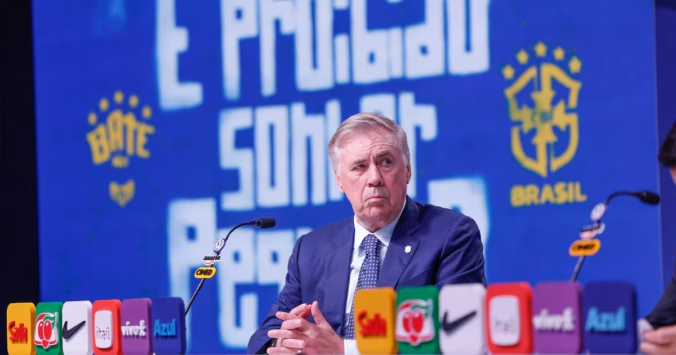
Welp, no matter how disappointing, how soul-sucking, Brazil’s premature World Cup exit felt, time marches ever forward, and the next World Cup cycle inevitably begins. Carlo Ancelotti, for better or worse, remains in charge of the Seleção and this time will have a full four years to explore the talent pool and build a new team rather than the one-year rush job of 2026. At time of writing, he has already announced Brazil’s squad for the upcoming “super FIFA date” tripleheader of games on the other side of the Pacific. Match info for all those is below, as is the squad list, but frankly I care less about that than the broader questions of what he should do to prepare Brazil for the 2030 cycle.
Let me start off with a fun little exercise that I cut from my previous article to keep its focus more on the World Cup that had just been played. I’m going to play a little…
2026 World Cup Keep or Dump
Who could still be in the picture in four years’ time, and who deserves to be? I’ve lumped all the players from the 2026 World Cup squad into a few categories. In parentheses is the age they’ll be at the start of the 2030 World Cup, and in italics are additional players who were in the picture during the lead-up to this World Cup, but did not make the final squad.
Too Old And Not Good Enough Anyway: Bad Danilo (38), Alex Sandro (39), Weverton (42), Léo Pereira (34), Neymar (38), Casemiro (38), Fabinho (36), Douglas Santos (36)
I don’t think there’s anything to be said about any of these guys. They were simply not good enough this summer, and what’s bleak is that in several of these cases there genuinely wasn’t anybody better we could have taken instead. It pains me to include Neymar here, but there’s no denying that he simply isn’t good enough now, and there’s no way that’ll change for the better in four years.
I initially had Douglas Santos in a separate category, feeling that he was pretty decent at the World Cup, but after rewatching the Norway game, I was less impressed.
Not Too Old But Probably Not Good Enough: Ederson (the goalkeeper) (37), Lucas Paquetá (32), Ibañez (31), Luiz Henrique (29), Matheus Cunha (31), Éderson (the midfielder) (30), Bento (31)
Goalies can have a pretty long shelf life, and we saw a lot of goalies well into their mid-30s excel at the World Cup, and not just guys like Vozinha who suddenly became household names. 37 would be pushing things—Fernando Muslera and Manuel Neuer, both on the wrong side of that number, didn’t have great tournaments—but I could see Alisson still being good enough to be worth considering. I can’t say the same about Ederson, who seems to be declining much more quickly with age.
It hurts to put Paquetá here, but as good as he could be, he wilted when the going got tough. He might not be useless in four years, but it’ll be a problem if we can’t find anybody better. It’s sort of the same story for Ibañez, Luiz Henrique, and Cunha: they’re not necessarily bad (okay, maybe Ibañez is), but if we’re still trotting them out in four years’ time, I don’t like our chances. Even Cunha, who tripled his Seleção goal tally at the World Cup and won the penalty that should have catalyzed a straightforward victory over Norway, just isn’t a very good goalscoring number 9, and he’s certainly not a Paolo Guerrero or Salomón Rondón type who can regularly pop up with goals for his national team even when he’s barely putting up numbers for his club.
Might Have One More World Cup In Them: Alisson (37), Marquinhos (36), Bremer (33), Raphinha (33), Éder Militão (32)
If Thiago Silva could start in Qatar at age 38, and had a decent case to make this year’s World Cup squad at age 41, it’s not unthinkable that Marquinhos could still contribute at age 36 in 2030. He was one of the team’s very fastest sprinters this time out at age 32, and sports science only keeps getting better; he might still have some juice four years from now. That said, good as Marquinhos is, he’s no Thiago Silva, and I doubt he would or should be starting at 36.
Should Have One, Maybe Two More: Bruno Guimarães (32), Gabriel Magalhães (33)
Perhaps I’m huffing some copium here, but we’ve seen the likes of Lionel Messi and Luka Modrić excel well into their mid-late thirties—any chance we could get a top-class midfielder who’s still good beyond age, like, 32? I’m not saying Bruno is on their level, but if we had two more of him, our midfield problems would be solved for several World Cups. Hopefully his is the sort of play style that can age like fine wine.
Should Be In Their Prime: Vini Jr. (29), Danilo Santos (29), Igor Thiago (28), Gabriel Martinelli (28), João Pedro (28), Rodrygo (29)
Won’t Peak Until 2034: Endrick (23), Rayan (23), Estêvão (23), Wesley (26), Andrey Santos (26)
These should be pretty self-explanatory. A couple might be borderline “probably not good enough”, but even those we’d expect to physically peak in 2030 could still be much more useful in 2034 than some of the decrepit fossils we dragged to this World Cup.
That all leaves 18 players who might be worth carrying over into the new World Cup cycle—a good two-thirds of a squad already! But those players are all holdovers from a World Cup squad that wasn’t very good, I have fresh doubts about some of them after watching them at the World Cup (Danilo Santos comes to mind), and others have sown fresh doubts with their choices and performances since the tournament. With that in mind, Ancelotti needs to approach the 2030 World Cup cycle with more than just picking 11 players out of a grab bag until he finds a lineup that works; now that he has the luxury of time, he needs some clearer organizing principles and goals. Here’s what I think—again, mostly originally written as a supplement to my last post—he should do to get Brazil ready for 2030.
What Ancelotti Needs To Do
Establish a dang midfield
In his post-mortem interview with Globo, Ancelotti talked about the need to “focus more on developing midfielders” for this coming World Cup cycle, and to work with clubs to make sure that happens. So he’s certainly aware of the problem, even if he apparently didn’t think it was enough of one to warrant building the 2026 team around a three-man midfield. If nothing else, I think this tournament demonstrated that a minimally competent midfield three—three guys who, even if they’re not particularly exceptional, are capable of moving the ball around, playing through a bit of pressing, and chasing down opponents when they have the ball—will do better than two men just tasked with shielding the defense and sending the ball up to the forwards. Hopefully we see some genuinely good players emerge in the sector, whether that’s Andrey Santos and João Gomes taking big steps forward at their new clubs,1 Breno Bidon and Gabriel Moscardo living up to their recent hype, Gabriel Sara making himself more visible with a move to a big European league, or somebody who isn’t on the radar yet making himself known.
But if nothing else, if at the next World Cup we’re starting every game with three midfielders who are all fairly mobile and decent at passing the ball, we’ll already be better off than we were in 2026… or 2022, when the midfield was just Casemiro and Paquetá… or 2018 or 2014, when Paulinho was a starter. That’s bleak to consider, but at least there’s lots of room for improvement.
Find a striker
If Brazil’s midfield is a source of frustration at least in part because it feels like a choice, like any one of our recent coaches could have easily assembled at least an okay midfield if he were so inclined and/or able to resist the siren song of trying to cram so many talented wingers into the starting lineup, the issue up top is more one of there just not seeming to be anybody capable of emerging as a reliable, consistent goalscorer. For years, everybody who’s showed a flash of promise has upon further examination proven to not be good enough. Gabriel Jesus ended up not having a clutch bone in his body (or maybe Pep Guardiola Hoovered them all out of him). Richarlison’s somewhat patchy Seleção form fell off a cliff once he started getting injured. Matheus Cunha was simply never a good enough goalscorer, and Igor Thiago, for all his raw numbers, doesn’t seem to have enough in his arsenal besides penalties, tap-ins, and rebounds. The exceptions have mostly been players we let slip out of our grasp, like Diego Costa, or whom we haven’t examined enough yet to chalk them off as disappointments.
That last category might describe João Pedro and Raphinha, albeit for very different reasons. Since moving to Chelsea, JP has blossomed into a prolific goalscorer, and while his raw numbers aren’t quite as good as Igor Thiago’s, he scores plenty of the kinds of difficult and spectacular goals that Igor simply does not. Here is somebody, in other words, who might actually have the mythical juice—that is, if he can ever overcome his record of total non-performance in a yellow shirt. I have panned him repeatedly in these virtual pages—”I have literally never seen him play well for Brazil. He’s always looked lost, on a completely different wavelength from every teammate around him“; “[while he might have a high ceiling], he’s never shown it for the Seleção, for whom his floor is in about the fifth or sixth circle of Hell by my estimate“—but he’s also only ever been capped eight times. Forget that the majority of those were under Ancelotti, who was not convinced that he should go to the World Cup: if João Pedro is a puzzle to be solved, a player who cannot manifest his obvious talents unless he is properly incorporated into the team and the system, now, with four years until the next World Cup, is the time to start putting the pieces together. Or, well, it would be, if the guy hadn’t gotten injured and had to withdraw from the squad. But I get ahead of myself.
In any case, the point I’m trying to make is that he is obviously gifted, and in the absence of anybody else with anything like his seeming potential, we should be spending some trying to see if we can Make Him Work for Brazil.
As for Raphinha, it’s a simpler case. He’s having a fucking amazing start to the season with Barcelona, with back-to-back hat-tricks against Racing Club and Sevilla last week bringing him to 14 goals in eight games, and he’s doing it because Hansi Flick is now playing him as an out-and-out center forward. Obviously, Brazil is not anything like this Barcelona, lacking both its pile of world-class creative talent surrounding Raphinha and a coach who plays that sort of ultra-aggressive, defensively-almost-suicidal playing style. I don’t think he’ll suddenly start playing like that if we stick him up top without any other consideration. But it’s also fair to say that neither Ancelotti nor Dorival Júnior before him ever really figured out how to get the most out of the guy for Brazil. Raphinha was the top scorer of the Dorival era, but entirely on the back of penalties and free kicks; he never scored from open play. Ancelotti, meanwhile, seemed to sacrifice his effectiveness in order to get the most out of Vini Júnior; Raphinha still has yet to score for Brazil since the Italian took charge. With that in mind, and especially since he’s clearly Brazil’s most in-form goalscorer at the moment, why not try him up top this month? He probably won’t be nearly this good at age 33 in 2030, but he’s such a good athlete, and takes such good care of himself, that it’s hard to imagine that he won’t still be good enough to handle a key role.
Try three at the back
I’m hardly the first person to suggest that Brazil’s talent pool might be better suited to playing three center-backs rather than a back four. We have a glut of talented center-backs—Vitor Reis, Alexsandro Ribeiro, Murillo, Natan, and Éder Militão are among those who missed this World Cup but could feature in 2030—and while a few young fullbacks like Wesley, Kaiki, and Viery are establishing themselves in Europe to some degree, we don’t have nearly as much quality on the defensive flanks as we do in the center. Furthermore, the Brazilian fullbacks who have managed to establish themselves in Europe recently have often played more as very attacking wingbacks playing ahead of, you guessed it, three center-backs. Meanwhile, if there’s one thing we do have, it’s talented wingers and wide attackers, some of whom are tremendously gifted athletes. Raphinha, for example, has the speed, stamina, and technical ability in the final third to be an excellent attack-first wingback.2 It’s probably too late, not to mention a bit insulting, to repurpose him as a defender, but we have such a glut of these sorts of forwards that Ancelotti took irresponsible risks with the team’s tactical setup to try and fit them all in. Converting a couple of them into wingbacks might genuinely be a more sustainable way to make the most of Brazil’s talent pool.
And let’s not forget that while Ancelotti isn’t known as a three-at-the-back manager, he has used it before…
Drop players who choose money over challenge
This feels less likely to actually happen than just about anything I’ve listed so far, but I think it’s a good principle to establish after the World Cup. Put simply, if you leave a top-tier league for a big paycheck in a mediocre league in the Middle East or anywhere else, you should be instantly removed from consideration for any and all Seleção activities until such time as you return to a competitive league and prove that you can still play at that level. The only direct example of this at the World Cup was Ibañez, who was awful, though you could very easily cite Neymar as well; even if his decline was more due to his injuries than his move to Saudi Arabia, you could well make the case that his move to Saudi Arabia indicated a complacency and loss of ambition, which later manifested in a lack of dedication to his fitness and left him profoundly hobbled by a neverending series of injuries by the time 2026 rolled around. But even beyond them, we see reminders all around that form in the petrostate leagues doesn’t necessarily carry over to more rigorous playing environments, one of the most recent examples being Marcos Leonardo, who is struggling mightily for Ajax after having looked like a dark horse candidate for Brazil’s striker role at Al-Hilal.
And yes, this means that Gabriel Martinelli should officially be persona non grata unless and until he leaves the Middle East. (I don’t know if we have enough evidence to exclude players in Russia or Ukraine on this basis. Maybe just Russia, since their clubs continue to be excluded from UEFA competitions. Depends on how much credit you want to give Luiz Henrique for playing well in friendlies—including against France—compared to being a non-factor at the World Cup itself.)
Break the Maldição do Gato
During a media availability with Vini Jr. ahead of Brazil’s quarterfinal against Croatia at the 2022 World Cup, a cat found its way into the room and made itself at home at the head table, at which point CBF advisor Vinícius Rodrigues unceremoniously tossed it to the floor.

Brazil subsequently lost to Croatia on penalties after conceding a backbreaking, deflected equalizer in the final minutes of extra time, and the entire World Cup cycle that followed was a nightmare, even leaving aside the loss to Norway that capped it off. This list of unwelcome firsts and worsts the team “achieved” makes for grim reading. Worst loss in World Cup qualifying history. Worst World Cup campaign in history. First World Cup qualifying loss at home ever, and separately, first World Cup qualifying loss to Colombia ever. And that list doesn’t even take into account the miserable performance of Brazil’s youth teams, including a worst-ever 6-0 loss to Argentina, two embarrassing U-20 World Cup exits, and failure to even qualify for the 2024 Olympics after winning the previous two gold medals, nor does it mention the incompetence and scandals that tore apart the CBF and somehow did not deter Carlo Ancelotti from agreeing to coach Brazil.3
In Brazil they call it the maldição do gato, the curse of the cat. I wouldn’t call myself terribly superstitious, and Brazil’s more profound curse, losing to every European team they’ve faced in the World Cup knockout rounds since 2002, predates this poor cat by decades. But I love cats enough that treating that cat badly left a bad taste in my mouth,4 and as far as I can recall, nobody ever apologized for it. I’m not saying the team’s record going fully down the toilet since the incident, or the subsequent World Cup losses to Croatia and Norway, two teams that, let’s be frank, aren’t on the level of 2006 France or 2014 Germany, are some sort of karmic repayment. I’m just saying we should at least do something to try and make the situation right. Tracking down a random cat living on the streets of Doha is probably impossible so long after the fact, but, I don’t know, make a big donation to some animal rescue efforts. Have Rodrigues volunteer at an animal shelter, or have him and Vini Jr. ceremonially, I don’t know, pick up some cats and put them down gently rather than throwing them to the ground. Pay off every Brazilian in the UAE second division to kick the shit out of Kurt Zouma at every opportunity. Pay no heed to evidence that attempts to break sports curses often don’t work, and instead note that England were nice to the cat that visited them in Qatar (to the point that Kyle Walker and John Stones adopted him and named him Dave) and then finished third this summer, the nation’s best World Cup performance since 1966.5
And if you need more convincing, just look at all the upstanding Brazilian footballers who love cats! Folks like… Dani Alves? Oh gosh. Never mind.
Well, with all that in mind, let’s compare it to the squad Ancelotti just announced for these upcoming games!
The Squad
Goalkeepers: Hugo Souza (Corinthians), Morisco (Coritiba), Otávio (Cruzeiro).
Defenders: Artur Dias (Athletico-PR), Douglas Santos (Zenit), Gabriel Magalhães (Arsenal), Jair (Nottingham Forest), Marquinhos (PSG), Matheuzinho (Corinthians), Mauro Júnior (PSV), Vitor Reis (Manchester City), Vanderson (AS Monaco; replaces the injured Wesley of Roma).
Midfielders: Andrey Santos (Manchester United), Breno Bidon (Corinthians), Bruno Guimarães (Arsenal), Danilo Santos (Botafogo), Douglas Luiz (Juventus), Gabriel Bontempo (Santos), Matheus Martinelli (Fluminense; replaces the injured João Pedro of Chelsea).
Forwards: Endrick (Real Madrid), Estêvão (Chelsea), Pedro (Flamengo), Raphinha (Barcelona), Rayan (Bournemouth), Samuel Lino (Flamengo), Vinicius Junior (Real Madrid).
(Maldição do Gato: unaddressed. But my family recently made a breakthrough with a semi-feral cat my parents brought indoors years ago, so maybe that’s a positive sign?)
So, how well did Ancelotti understand the assignment? He’s certainly made some drastic changes: only nine of these players were in the World Cup squad, and four of the holdovers are forwards, the position where continuity makes the most sense. I count seven new faces aged 22 or younger in addition to already established youths like Endrick, Estêvão, and Rayan. Ancelotti has totally refreshed the goalie trio and gone straight for youth in the center of defense as well: forget the likes of Murillo or Natan, because apparently 24-25 years old is too old for a fresh face. And Arthur Dias has been playing on the left side of a back three for Athletico, if Sofascore is to be believed, so maybe there’s even some hope for the back three experiment.
On the other hand, the fullback selection might suggest otherwise. Rather than go for younger names like Kaiki or Viery, or bring back an older player like Carlos Augusto who has much more top-level experience, Ancelotti opted to bring back Douglas Santos—easily the most questionable of the World Cup holdovers—and, after Wesley had to withdraw due to injury, filled out the group with Matheuzinho and Mauro Júnior, two 26-27-year-olds who might have you asking “wait, who?” (Admittedly, Mauro Júnior was a mildly hyped prospect at attacking midfield like a decade ago.) Maybe they’re capable wingbacks; I’m not familiar enough with them to know. I know Douglas Santos and Vanderson aren’t. Generally, this seems to be a group of capable fullbacks at best and nothing more, so the position could still be a problem.
I appreciate the thorough refresh in midfield, with only Bruno and Danilo being retained from the World Cup squad, and the simple numbers at play, especially since Ancelotti added a seventh midfielder once striker João Pedro had to be cut. So hopefully we at least see a midfield three (or even four) that has a clear, well-understood tactical assignment and makes for a better, more watchable team than we had at the World Cup. Are the individual players on offer particularly good? That I don’t know. I talked above about my fresh doubts regarding Danilo, moving to Manchester United doesn’t seem to have lifted Andrey Santos any higher than the plateau he was experiencing at Chelsea, and Douglas Luiz’s career completely stalled after he left Aston Villa. I’m not familiar enough with the other three to know what to expect from them. But there’s so much room for improvement here that any combination of midfielders feels like it should be better to at least some degree.
Among the forwards, the two new (well, returning after a while) faces, Pedro and Samuel Lino, are both having quite prolific seasons for Flamengo; the main knock on them may be that they’re just already a bit too old to seriously expect that this is a level they can sustain, especially given that neither was especially impressive during their previous, albeit brief, opportunities for Brazil. And Pedro is probably worth a look as a number 9 because he is a pretty reliable goalscorer, though his profile as a player is perhaps a bit archaic: he has the footwork to fashion an opening for himself to take a shot, or to turn and play in a teammate, but he’s also not mobile enough, in my recollection, to run the channels or contribute much to a press. Still, for all I’ve said about his age, he’ll only turn 33 on the eve of the next World Cup final, and we’ve seen plenty of number 9s sustain their goalscoring form, or even have the best seasons of their career, even further into their 30s than that.
That said, I have to admit that I’m more curious to see Raphinha given a try up top right now. Something tells me Endrick won’t see too many minutes given that he’s coming off an injury and keeps getting shoved down the depth chart at Real Madrid every time Florentino Pérez shells out another dumptruck full of money for a shiny new forward who will totally, I’m serious you guys, this time it’ll work for sure, fix the problems caused by the team already being overloaded with star attackers.
Also, and unrelated to anything else, Jair and Gabriel Bontempo have known each other since they were 10 years old! The two were in Santos’ youth system and when Jair didn’t have a place to live, Gabriel’s family let him live with them for a year. Now they’re reunited for their first games with the Seleção! I think that’s very cute.
Alright, here are the games:
Brazil’s Schedule
Brazil vs. Australia
Friday, September 25, 2026
Queensland Country Bank Stadium, Townsville, Queensland, Australia
Kickoff: 6:00 AM EDT / 7:00 AM BRT / 10:00 AM GMT
US TV/Streaming: none
Brazil vs. Australia (again)
Tuesday, September 29, 2026
Suncorp Stadium, Brisbane, Queensland, Australia
Kickoff: 6:00 AM EDT / 7:00 AM BRT / 10:00 AM GMT
US TV/Streaming: none
Brazil vs. India
Saturday, October 3, 2026
Vivekananda Yuba Bharati Krirangan Stadium, Kolkata, West Bengal, India
Kickoff: 10:00 AM EDT / 11:00 AM BRT / 2:00 PM GMT
US TV/Streaming: none
This jumbo-sized FIFA date could have allowed us to play a fourth game, as most European teams are doing on account of the Nations League. In a vacuum, however, I’m fine with us only playing three, given the enormous travel and jet lag6 involved. (I’m sure the players’ clubs are very happy they’ll be getting home a week before league play resumes rather than three days.) But these eclectic, remote matchups are cause for concern. Some of it’s down to the Nations League eating up every European team’s availability, sure, but if the CBF keeps settling for third-rate games against fourth-rate opposition twenty-four hours of flying away from Brazil or Europe, and still can’t fill up their schedule by doing so, we’ll have to worry once again about both their competence at organizing games and whether they care at all about trying to get decent opponents for Brazil as opposed to just lining their own pockets.
That said, not every team we’re scheduled to face is fourth-rate. Australia had a decent World Cup, shocking Turkey in their opening game, making it to the knockout rounds, and pushing Egypt to penalties in the round of 32. I’m not familiar with their talent pool, but they’ve gone for more post-World Cup continuity than us, bolstered by some of the young talents who broke out during the tournament like Lucas Herrington and Nestory Irankunda. We generally beat Australia handily when we play them (in friendlies at least), but with all the travel and growing pains of a significantly changed squad, I think we maybe draw one of these games 1-1 and win the other 2-0.
(They play in yellow; I wonder if we’ll have to play in blue for both games?)
This will be the first match between Brazil and India, and I’d be shocked if this is anything but a total cakewalk. India will be motivated by their biggest match in—wow, a whole generation; their last game against a World Cup winner was against Argentina at an invitational tournament in 1984—but they’re a team that struggles to beat the likes of Singapore (who, incidentally, we’re scheduled to play in November). I’m predicting a 5-0 win, but frankly, that might be conservative. I don’t think seven, eight, maybe more goals are out of the question if Brazil are sufficiently motivated (though I could very much see Ancelotti letting off the gas rather than rack up the score).
- Early indications on these two are not promising. ↩︎
- Can you tell I wrote this bit before he started popping off as a center forward? ↩︎
- Even the women’s team wasn’t totally immune, crashing out at the group stage of the 2023 World Cup, but they made up for it with a totally unexpected silver medal at the Paris Olympics. ↩︎
- 2026 also hasn’t been the best year for treatment of cats in media, whether it’s Obsession or the latest season finale of Rick and Morty. ↩︎
- Speaking of England’s off-field activities during the World Cup, please enjoy this clip of the team attempting to enjoy Ed Sheeran visiting their training camp to play them a private acoustic set, which has been on my mind this week for, uh, no particular reason whatsoever. ↩︎
- Speaking of which, anybody see the story of the Los Angeles Rams trying to hack jet lag by flying to Melbourne just hours before their NFL season opener, only to get smeared to paste by a San Francisco 49ers team that had actually taken a few days to acclimate and enjoy the trip and the city? Let that be a cautionary tale. ↩︎
Recent Comments