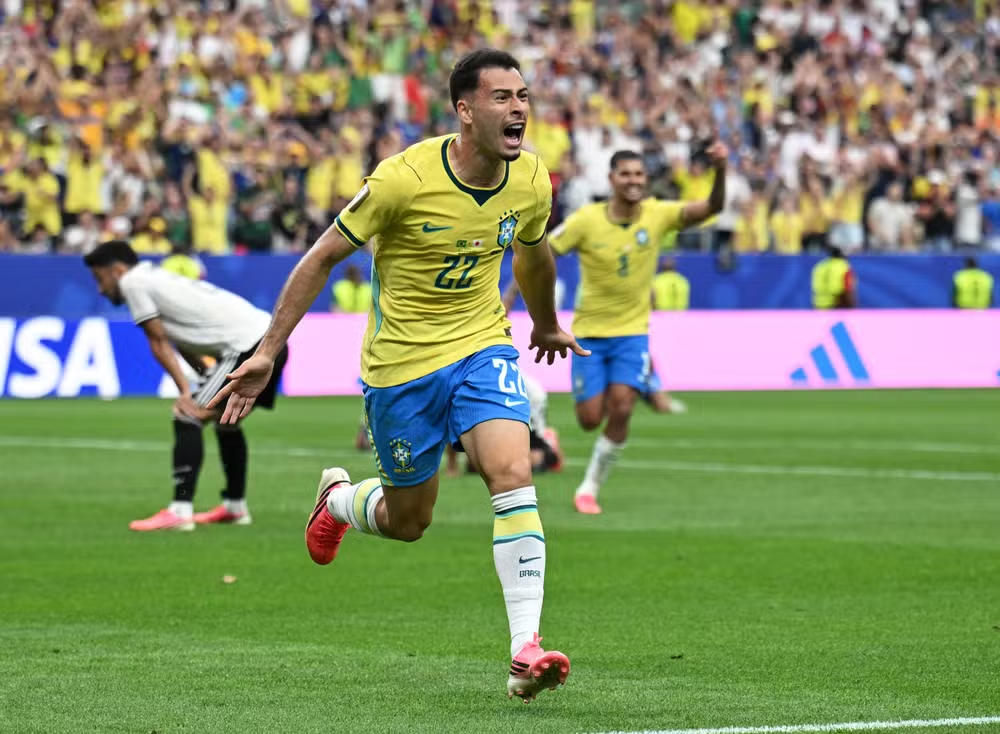
Well, I correctly predicted the score of the Japan game, though I don’t think it was right to say it “[wouldn’t] feel quite as close as the scoreline suggests”. While Brazil undeniably controlled the game, we didn’t turn our dominance into much in the way of clear opportunities, and Japan took the lead off, well, very much the same kind of goal that has doomed the Seleção at recent World Cups. At one point early in the second half, Casemiro had a point-blank header that ricocheted off three Japanese defenders without ever crossing the line or falling to a Brazilian to tap the ball home, and I couldn’t help but think, that’s the sort of lucky break a team gets when they’re fated to win. But just a few minutes later, Casemiro popped up in the box again and this time buried his header, and after some more huffing and puffing, Gabriel Martinelli silenced his doubters (me) with the game-winning goal in the fifth minute of stoppage time.
I do have a few complaints to make, mostly about how this victory felt more labored than it probably should. But let me start with the more positive spin. Brazil hasn’t won a hard-fought, come-from-behind game like this one at the World Cup in forever. In fact, the last time Brazil fell behind and still won in the knockout rounds at the World Cup was in the 2002 quarterfinals against England. That 24-year gap is the longest between such comebacks in the team’s history. And it’s not like Brazil had better outcomes in lesser tournaments. Across all the tournaments the senior and Olympic teams have played since then, I found only three such comebacks in the knockout rounds:
– With the last kick of the 2004 Copa América final against Argentina, Adriano scored arguably the most clutch goal in Seleção history to tie the game at 2-2 and send it to penalties, where Brazil won. This is also one of only a handful of times where we scored a game-changing goal in second-half stoppage time, and the only one in the knockout rounds. (Philippe Coutinho against Costa Rica at the 2018 World Cup and Casemiro against Colombia at the 2021 Copa América also come to mind.)
– In the 2009 Confederations Cup final, we spotted the USA a 2-0 lead at the half before coming back to win 3-2.
– In our 2012 Olympic quarterfinal, Honduras twice took the lead, although we completed the comeback by the 60th minute and won 3-2.
I didn’t keep a close count, but it seemed far more common for these sorts of close games to emerge because Brazil scored first and then conceded a tying goal before retaking the lead (see also: Brazil 3-2 Netherlands, 1994) or collapsing (see also: Brazil 1-2 Netherlands, 2010). A team like Brazil obviously doesn’t fall behind in games all that often, but they’ve rarely been able to demonstrate poder do reação—power to react—like they had to do on Monday.
Because, remember: we can argue that the performance was poor in several ways, but when it came down to it, faced with the exact situation—conceding a goal(s) partly because Casemiro (or his replacement) couldn’t make a crucial stop in midfield and Alisson didn’t really do anything wrong but it just feels like maybe he needs to be saving those chances if we want to win a tournament like this, does it?—that led to our exit from the past two World Cups, this time we had the poder do reação to turn things around and advance.
Still, a few words on things that bothered me or that I otherwise found interesting.
First of all, I can’t say I’m thrilled that it felt like Brazil let off the gas after equalizing. There was about a ten-minute stretch from minute 50 to 60 or so in the second half where, on a different day, we could have easily scored three goals. First was the Casemiro header I mentioned earlier that pinballed in the box, then his equalizer, then Vini Jr.’s solo almost-golaço that Zion Suzuki tipped onto the post. After that, though, it’s like Carlo Ancelotti was content to manage the game and even let it be decided in extra time. We took just two shots in the next 30 minutes (admittedly including a commercial hydration break) and while we had a bit of a late flurry while the game inched into stoppage time, we didn’t create any clear opportunities until Bruno Guimarães found Martinelli in a pocket of space for the dramatic late winner. It all worked out, but we were dangerously close to adding another 30 minutes of wear and tear onto our players at a very early stage of a long and grueling knockout phase, and much like the Haiti game, it felt like Ancelotti chose to drop the intensity level more than he perhaps should and count on things all shaking out in the end. It’s now worked out twice—we still won the group despite not racking up the score on Haiti, and we still beat Japan in regulation—and perhaps I should just take this to mean that, just as he’s done for his entire career, Ancelotti knows his players and his gameplan well enough to have faith that they’ll get the job done when it counts.
Maybe a more interesting point is how Martinelli played after he came on. While his winner obviates several years of agonizing near-misses in far less important games, I want to instead talk about how Ancelotti used him in midfield. Martinelli genuinely played as part of the midfield line, not really trying to dribble forward or even shoot from deep, more just passing the ball sideways and helping it circulate. What he did do was fight for the ball aggressively, using his speed and fresh legs to hassle Japan’s players. Even without directly registering any tackles, he helped slow Japan down and maintain Brazil’s control over the game. I hadn’t really considered it before, but I think this is part of why Ancelotti has stuck to his 4-2-4 guns as much as he has: with so many forwards who are more athletic than any of the midfielders on offer, he can use their speed to reinforce the team defensively.
So Martinelli has redeemed himself, at least until the next time I feel like he’s not really doing anything useful. But what about Casemiro? He scored the crucial equalizer, and he was terribly unlucky to have not scored from another header moments before. Without a doubt, he played a crucial role in Brazil’s comeback.
But let’s roll the clock back to Japan’s goal. He couldn’t keep up with Kaishu Sano—or was it that he couldn’t, but that he chose not to? And why did he choose not to? Well, because he was already on a yellow card and knew a tactical foul would probably get him sent off. I think it was the right call to not risk it—the game was still tied and Brazil would have had to spend at least 60 minutes down a man.
But why was he already on a yellow card? Well, I was going to say at first because he made a really fucking stupid tackle. He’d already whiffed on cutting out Hiroki Itō’s pass to Junya Ito, which left him a mile behind the play, before Lucas Paquetá successfully held up Ito long enough for him to mostly catch up. Ito managed to cut Paquetá out of the play, leaving him with a decent little pocket in front of the defenders to line up a shot:

The tackle Casemiro made here was absolutely terrible, without a prayer of getting the ball, and while Ito had some space to line up a shot, he wasn’t on his strong foot (he’s right-footed), and Bruno Guimarães might have been able to close the space if he’d aimed to shift onto his stronger foot. In that context, this looks like a poor decision to burn up his yellow card so early to block a very low-percentage opportunity.
On the other hand, the goal came from Sano finding a very similar pocket of space:

Perhaps the bigger issue here is that Casemiro twice let Japanese players get on his bad side, and the rest of the team afforded them about an 8-yard space to take a shot. Perhaps we could leave it at that, but for the fact that this is the second straight World Cup elimination game where we’ve conceded a goal because Casemiro was already on a yellow and didn’t feel like he could make a potentially goal-saving tactical foul. And wouldn’t you know it, I looked back at the yellow card he got in that Croatia game and it was also quite stupid.
I wouldn’t go so far as to say I’ve been a Casemiro skeptic for a while, but I have previously beat the drum about him not being as consistently good as we want him to be. Of his performance in the 2019 Copa América, I wrote, “[h]e repeatedly coughed up possession with shaky passing, his tackling and fouling often played with fire, and opponents were repeatedly able to play around him.” He’s only physically diminished since then, in particular becoming one of the slowest players at the tournament. While he has developed his game in other ways to compensate, most notably by developing that very ability to pop up for crucial goals that helped save us on Monday, that lack of recovery speed has been terribly evident at moments throughout this tournament.
And, lest we forget, he ran into his own teammates, cartoon-style, twice in the first half.
But anyway, let’s get on to Sunday’s game.
Brazil vs. Norway
MetLife Stadium (AKA New York New Jersey Stadium), East Rutherford, New Jersey, July 5, 2026
Kickoff: 4:00 PM EDT / 5:00 PM BRT / 8:00 PM GMT
US TV: FOX, Telemundo
US Streaming: FOX One, Peacock
Likely Starting XI: Alisson; Danilo, Marquinhos, Gabriel Magalhães, Douglas Santos; Casemiro, Bruno Guimarães, Danilo (Gabriel Martinelli); Rayan, Matheus Cunha, Vini Jr.
On The Bench: Ederson, Weverton; Ibañez, Bremer, Léo Pereira, Alex Sandro; Fabinho, Éderson; Neymar, Igor Thiago, Gabriel Martinelli (Danilo), Luiz Henrique, Endrick.
Whither Brazil?
Raphinha has finally returned to training with the team, but it sounds like he’s still one game away from returning. Casemiro and Lucas Paquetá came off injured against Japan, though Casemiro seems to be fit to play. Paquetá, however, has a grade 2 injury to his left hamstring, and the odds of him being able to return before the World Cup is over are slim.
Paquetá’s situation is interesting. As excellent as some of his play, particularly his passing, has been over the past month, it’s also increasingly clear that he can’t step up his game when the going gets tough. Maybe he just isn’t good enough to pick out those stellar passes against teams with a bit more ability to close down the space, but he also seems to get flustered easily and make stupid mistakes. It’s possible that his first half against Japan was partly the product of the injury that ultimately took him out of the game—he was clutching his hamstring, though not the one that is apparently injured, after a foul just a minute in; in the tenth minute he took a shot from Bruno Guimarães right to the face; and he was the victim of at least one of Casemiro’s teammate-clobberings—but along with his performance against Morocco, it was clearly of a lower standard than his showings against Scotland or Haiti.
But he’s also, at this point, clearly the team’s best line-breaking passer, even if he’s somewhat inconsistent. Bruno, to be fair, has also been good, and has more assists, but doesn’t have the same capacity to play the sort of through balls that put Vini in behind. Casemiro is a crapshoot as to whether his forward passes will be beautifully weighted or horrible giveaways. Right now it sounds like Good Danilo may be leading the race to replace Paquetá, and while he’s a really fun player with a real nose for scoring goals, he’s not nearly as good of a playmaker and I’m also doubtful that he’s as capable of competing physically in the midfield. I think that lack of playmaking is more likely to be a liability for Brazil.
The position might instead go to Martinelli, based on late-breaking news from Friday’s training camp, and this I’m less sure about. Yes, Martinelli did well in a midfield-ish role off the bench against Japan, but he also wasn’t asked to offer much in the way of incisive passing or dribbling, and his defensive contributions were definitely helped by his coming on as a substitute against tired legs. Then again, against a potentially weaker defense than Japan’s (more on that in a moment), having a quicker player who can bring the ball forward on the break may be more valuable.
The Opposition
Here’s a stat for you: Norway are the only nation Brazil has ever played and not beaten once. Four games, two draws, two losses, most infamously a 2-1 loss in the 1998 World Cup group stage.
While that’s an intimidating stat, we shouldn’t read too much into it. Our other three games against them were all played in Oslo, and the last one was 20 years ago. There’s nothing about those old results that applies to the current teams.
That said, there are some very intimidating things about this current Norwegian team, most notably the six-foot-five steam train made flesh that is Erling Braut Haaland. While it feels sacrilegious to compare him to a young Ronaldo, as Haaland isn’t even in the same galaxy when it comes to technical ability, he has the same sort of physical gifts that make him look like a vastly superior athlete next to pretty much anybody he encounters on a football pitch. He’s not likely to dribble past anybody, but there may be nobody you’d less want chasing down a 50/50 ball against your center-back. Though if there’s any center-back who might be able to hold his own against Haaland, it’s Gabriel Magalhães, who knows him very well from many fraught matches between Arsenal and Manchester City in recent years. They’ve developed quite the rivalry, and while they’ve both said things about it all being in good fun and enjoying the challenge of playing against each other (Gabriel called him the toughest player he has to face in the Premier League), there’s been enough trash talk and worse that I have to think there’s some actual bad blood there. (I will admit, Haaland tossing a ball at Gabriel’s head and then running away like a little kid who knew he just got away with something was pretty funny.)
Norway also have a few other scary attacking players, most notably Martin Ødegaard, Gabriel’s Arsenal teammate. Alexander Sørloth hasn’t done much at this World Cup, but he’s been prolific for Atlético Madrid; Antonio Nusa might have had his breakout moment with his beautiful goal against Ivory Coast; and Oscar Bobb is a pretty good talent to have on the bench. It’s a group of players that can certainly make the most of a few slender opportunities and give Brazil an unpleasant surprise. However, the rest of the team isn’t nearly as impressive. Norway’s defensive record speaks for itself: seven goals conceded in three group stage games ties them with Sweden and Algeria for the most among all teams to advance to the knockout rounds, and both Sweden and Algeria have already gone on to lose their round of 32 matches. In Norway’s defense, four of those goals came when they opted to rest Haaland and several of their other starters against France. Perhaps they thought that saving Haaland and co. for a hypothetical round of 16 matchup against Brazil would give them a better chance of winning than facing France right then and there, or maybe they liked our side of the bracket more, who knows. In any case, they have yet to keep a clean sheet so far at the World Cup, though they held Ivory Coast to a single goal in the round of 32. Either way, while their attack scares me more, I think their midfield and defense could give us less trouble than Japan’s did. If they manage to score a couple of surprise goals, we’ll probably need their defense to be softer to compensate.
One other factor could be the weather. We’re back in beautiful New York New Jersey Stadium for this game, and for those unaware, this region of the country is currently in the throes of an absolutely brutal heat wave right now. I’m writing this on the second straight day of 100-plus-degree weather, and while that streak is likely to end tomorrow, the forecast of 99 degrees means it’ll be no reprieve at all. However, the match isn’t until Sunday, when the heat is finally expected to break, with a high in East Rutherford of a downright chilly 84 degrees. While I’m happy the heat is ending, for the sake of my own comfort and my electricity bill, I can’t help but wonder if a hotter day would have given Brazil more of an advantage against a team full of people who all grew up in a country where summertime temperatures rarely get too far above the mid-70s.
That said, I got the numbers above from weather.com, before turning to AccuWeather because it also predicts the heat index. Not only does it predict a slightly warmer 87 degrees on Sunday (not to mention 92 degrees for me on Saturday, which sounds a hell of a lot better than 99 right now), but it still predicts that it’ll be humid enough to feel like 101 degrees.

So hopefully that all gives us some advantage. I also have to wonder how the hell either team has been able to train at all this week; Brazil of course are staying just up the road in Morristown, while Norway’s World Cup base camp in Greensboro, North Carolina is currently just as hot.
All that said, I think we’re the better team and we should expect to win. But in some ways, this feels like our most high-stakes game of the tournament. With the extra knockout round this year, the round of 16 now represents our fifth game—the game where we’ve lost in four of the last five World Cups, each time to the first European team we faced in the knockout rounds. If this is a curse, we may never have a better chance to break it (and to end our bizarre winless record against Norway). Even if we go on to lose in the quarterfinal, that extra knockout win, and the end of the first-European-opponent curse, would feel like at least some progress in my book, like this legendary manager we hired at great expense has unequivocally moved the mess of a team he inherited in a positive direction. Obviously, for plenty of us another quarterfinal exit wouldn’t be nearly enough, and even I don’t think I could call this World Cup an unequivocal success unless we at least make the semifinals and don’t suffer another 7-1. (I still daren’t dream that we can actually win the thing.) But a round of 16 exit would be an unequivocal failure, and that specter will loom over this game. Again, though, I think we should win this game, and I could see us even having an easier time than we did against Japan. I’m going to predict a 3-2 win for us, with Norway getting a late goal that makes us sweat but ultimately just makes the game look closer than it was.
Recent Comments